Pivoting Onto Moving Ground: When the Field You're Entering Is Being Rewritten
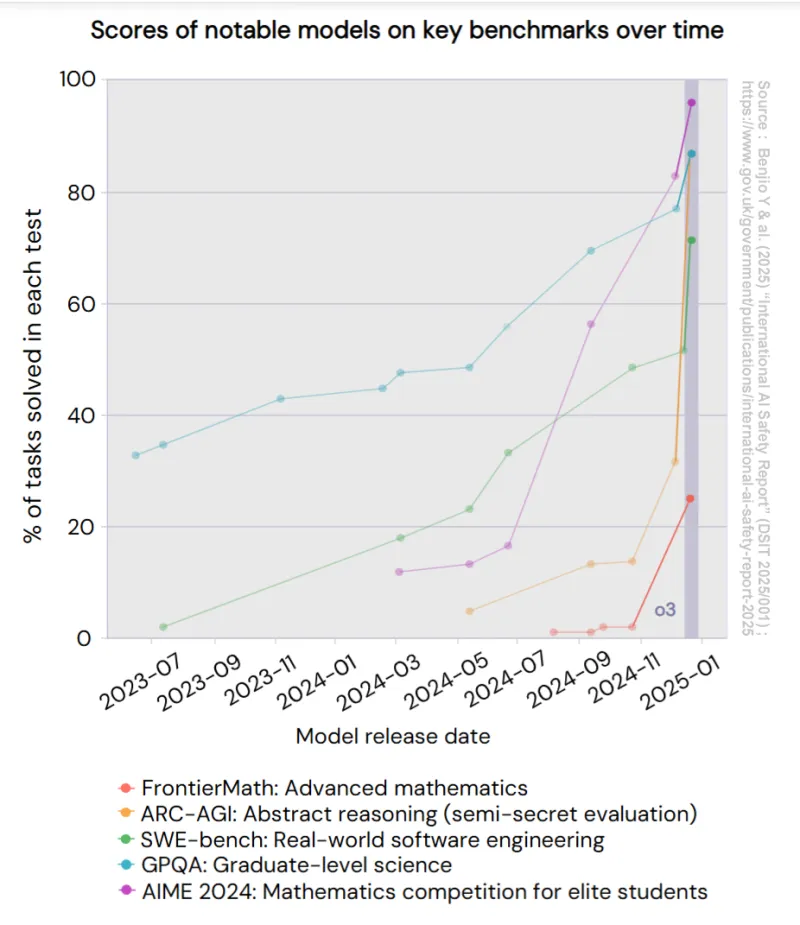
Photo: Y. Bengio, S. Mindermann, D. Privitera, T. Besiroglu, R. Bommasani, S. Casper, Y. Choi, P. Fox, B. Garfinkel, D. Goldfarb, H. Heidari, A. Ho, S. Kapoor, L. Khalatbari, S. Longpre, S. Manning, V. Mavroudis, M. Mazeika, J. Michael, J. Newman, K. Y. N
Here is the question almost no career changer asks: not can I get into this field? but what will this field look like when I get there?
The standard transition playbook—research the occupation, earn the credential, apply for entry-level roles—assumes the destination is stationary. In a growing number of American industries, that assumption is failing. Generative AI is actively reshaping the daily work of paralegals, copywriters, customer support specialists, junior software developers, radiology technicians, and translation professionals. A career changer who spends eighteen months retraining for a role may arrive to find the role has been redesigned around them.
This is not an argument against pivoting. It is an argument for adding one more lens to your research—one that most transition advice still omits.
Auditing the Trajectory, Not the Job Posting
Job postings describe the present. You need to estimate the future. Three practical checks:
Follow the money in the workflow. Ask insiders which tasks their employers are actively trying to automate or reduce. If the tasks you would spend your first two years mastering are the ones being automated, you are training for a runway that is shortening under your feet.
Look at entry-level hiring patterns. AI tends to compress the bottom of the skill ladder first—the routine work juniors traditionally cut their teeth on. If a field's entry level is thinning, ask what the new on-ramp looks like. Sometimes it has moved; it has rarely vanished entirely.
Distinguish tasks from occupations. Automation rarely eliminates a whole job; it eliminates the parts of a job. The paralegal who does document review by hand is exposed. The paralegal who supervises AI-assisted review and owns client relationships is not. Your research should map which side of that line your target role sits on.
Why Being New Can Be an Advantage
The conventional wisdom says disruption punishes outsiders. The evidence increasingly suggests the opposite.
Incumbents carry the heaviest burden in a disruption: sunk costs, established habits, compensation built on a workflow that is disappearing. A twenty-year veteran of a transformed field must unlearn; a newcomer has nothing to unlearn. When tools change, the gap between a second-year practitioner and a twentieth-year one narrows dramatically.
Career changers also tend to arrive with exactly the profile disrupted industries now prize: judgment, communication, domain knowledge from another sector, and adaptability demonstrated in the most concrete way possible—you changed fields on purpose. The professionals who thrive after disruption are rarely the ones with the deepest roots in the old workflow. They are the ones who treat the new tools as native terrain.
Building a Disruption-Resistant Pivot
Three adjustments to the standard playbook:
Choose the human-adjacent version of the role. Within any field, some functions center on judgment, trust, accountability, and interpersonal complexity—work that resists automation longest. Steer toward those.
Make tool fluency part of your retraining. Whatever your target field, budget real hours to learn the AI tools entering it. This is not a separate skill; it is now part of the occupation, the way spreadsheet competence became part of finance.
Shorten your feedback loops. In a fast-moving field, an eighteen-month retraining plan built around a static curriculum is a liability. Favor programs that update their content frequently, and build in quarterly check-ins with working insiders to confirm your plan still matches reality.
The Greater Risk Is Standing Still
It is tempting to conclude that disruption makes pivoting too dangerous—that the safe move is to stay put. But the fields being transformed by AI include the ones career changers are leaving, too. Stability based on the hope that your current employer remains untouched is not a strategy; it is a bet you placed without examining the odds.
The ground is moving everywhere. The question is not whether to move, but whether to move deliberately—eyes open, trajectory mapped, positioned where the change works for you rather than against you. For career changers, that positioning may be the single greatest advantage you have.